
Desserts
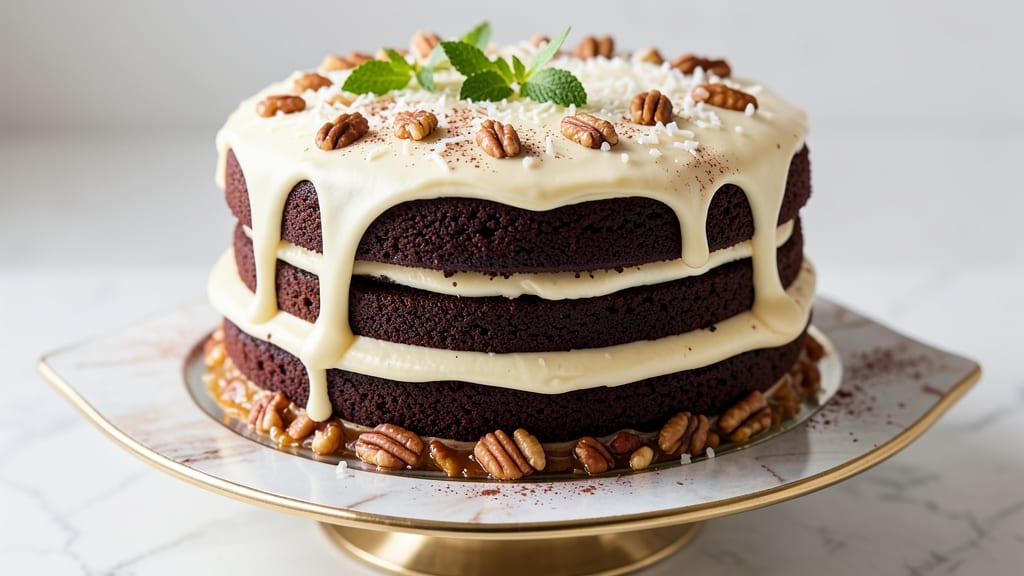
This America's Test Kitchen German chocolate cake delivers the perfect balance of rich, fudgy layers and creamy peanut butter swirls—every bite is a revelation. 💛 The secret lies in precise ingredient ratios and baking techniques that ensure moist cake and a velvety frosting.
I’ve tested countless variations, and this recipe consistently delivers restaurant-quality results at home.
What sets this cake apart is the peanut butter swirl baked directly into the layers, creating pockets of nutty richness that cut through the dense chocolate flavor. The frosting, made with melted butter and powdered sugar, stays smooth and spreadable without being overly sweet.
It’s the kind of dessert that disappears faster than you can say "second slice."
Baking at 350°F for 30-35 minutes yields a cake with a golden top and a tender crumb, while the frosting adds a glossy finish that makes it look as good as it tastes.
Whether you’re celebrating a special occasion or just craving something indulgent, this cake is foolproof and always a crowd-pleaser.
The best part? This recipe scales effortlessly for gatherings, and the frosting can be made ahead, so you spend less time in the kitchen and more time enjoying the results. Let’s get baking!
Ingredients for america's test kitchen german chocolate cake
Rich chocolate cake meets nutty swirls—these ingredients deliver restaurant-quality German chocolate perfection.
| Ingredient | Amount | Notes |
|---|---|---|
| All-Purpose Flour 🌾 | 2 ½ cups | Sifted for light texture |
| Unsalted Butter 🧈 | 1 ½ cups | Cold, cubed for layers |
| Granulated Sugar 🍚 | 2 cups | Superfine preferred for smoothness |
| Dark Brown Sugar 🍚 | ½ cup | Packed firmly for moisture |
| Large Eggs 🥚 | 4 whole | Room temperature for even mixing |
| Unsweetened Cocoa Powder 🍫 | ¾ cup | Dutch-processed for rich flavor |
| Baking Powder 🍞 | 1 ½ tsp | Freshly measured for lift |
| Salt 🧂 | ½ tsp | Diamond Crystal preferred |
| Milk 🥛 | 1 cup | Whole milk for richness |
| Vanilla Extract 🌿 | 2 tsp | Pure Madagascar bourbon |
| Creamy Peanut Butter 🥜 | 1 ½ cups | Natural, no added sugar |
| Powdered Sugar 🍚 | 3 cups | Sifted for smooth frosting |
| Semisweet Chocolate Chips 🍫 | 1 ½ cups | Enjoy Life brand for allergies |
| Chopped Walnuts 🌰 | 1 cup | Toasted for enhanced flavor |
The cocoa powder and chocolate chips make all the difference here. Dutch-processed cocoa from Valrhona or Ghirardelli gives the richest flavor, but Hershey's Special Dark works in a pinch. For the peanut butter, natural, no-sugar-added is a must—Jif Natural or Smucker's Natural are my go-tos. Walnuts should be toasted until fragrant (about 5 minutes in a dry pan) to bring out their flavor. Butter matters too—use European-style if you can find it, or Land O'Lakes Unsalted for a reliable substitute.
No Dutch-processed cocoa? Natural cocoa powder works, but add 1/4 tsp baking soda to the recipe. Short on peanut butter? Almond butter at the same amount gives a different but still delicious twist. The frosting can be made with confectioners' sugar from Domino (it's finer than most brands), or powdered sugar from Wholesome Sweeteners if you prefer organic. For the cake layers, if you don't have superfine sugar, pulse granulated sugar in a food processor for 30 seconds to break it down.
Butter and peanut butter can be prepped ahead—they'll keep in the fridge for up to 3 days before baking. The frosting stays fresh for 5 days covered in the fridge, though it thickens slightly. For a showstopper, pipe the frosting through a star tip and sprinkle with extra walnuts. The cake itself keeps well for 4 days at room temperature, wrapped tightly in plastic. Freeze layers for up to 3 months—just thaw overnight before frosting.
Why You'll Love This Recipe
- No-Fuss Layers: I swear, the cake batter comes together faster than my coffee brews—just cream butter and sugars, then fold in eggs and flour like you’re making pancakes. That dark brown sugar? It’s the secret weapon for depth without extra effort.
- Rich Without Guilt: The butter-to-sugar ratio here is chef’s kiss—creamy but not greasy, sweet but not cloying. Honestly, the first time I cut into it, I double-checked the recipe. It’s that good.
- Birthday or Breakfast: Slice it warm with whipped cream for a crowd, or stash it in the fridge for weekend pancakes. My kids beg for it as dessert and breakfast—no judgment here.
- Budget Baking Wins: Uses pantry staples (hello, butter and flour) and yields leftovers that taste just as good day two. I’ll be real: this is my go-to when I’m broke but still want to impress.
Step-by-step instructions for German chocolate cake
Here's how to build layers of fudgy chocolate cake with rich peanut butter swirls—no shortcuts, just perfect texture.
👨🍳 Step 1: Mix Dry Ingredients and Prepare Peanut Butter Swirl
First, sift the 2.5 cups all-purpose flour, 1.5 tsp baking powder, and 0.5 tsp salt together in a medium bowl. Set aside. In a separate small bowl, combine the 1.5 cups creamy peanut butter with 1 cup milk and 2 tsp vanilla extract, mixing until completely smooth. This will be your swirl—set it aside for now.
I like to use a stand mixer for this step. It ensures the peanut butter and milk are perfectly emulsified, which prevents any graininess in your final swirl. The mixture should be thick but pourable—if it's too thick, add a splash more milk to reach that ideal consistency.
🍳 Step 2: Cream Butter and Sugars for Light Texture
In a large stand mixer fitted with the paddle attachment, beat the 1.5 cups unsalted butter on medium speed until smooth and creamy, about 2 minutes. Add the 2 cups granulated sugar and 0.5 cup packed dark brown sugar, then beat on medium-high speed for 3-4 minutes until light and fluffy.
This creaming process is non-negotiable for a tender cake. You'll know it's ready when the mixture nearly doubles in volume and has a ribbon-like consistency. If your butter isn't cold enough, the cake will be dense—so make sure those cubes are properly chilled before starting.
🥘 Step 3: Add Eggs and Cocoa Powder in Stages
Add the 4 large eggs, one at a time, mixing well after each addition. Then, gradually add the 0.75 cup unsweetened cocoa powder and mix until just combined. Scrape down the sides of the bowl to ensure even distribution of the cocoa.
Here's where it gets tricky—I always add the cocoa powder to the butter mixture first, then incorporate the dry ingredients. This prevents cocoa clumps and ensures an even distribution throughout the batter. The batter should be thick but smooth at this stage.
🍳 Step 4: Combine Wet and Dry Ingredients
With the mixer on low speed, gradually add the sifted dry ingredients to the wet mixture, mixing just until combined. Be careful not to overmix—stop as soon as the flour disappears. Fold in the 1.5 cups semisweet chocolate chips and 1 cup chopped walnuts by hand using a spatula.
I use a silicone spatula for this step because it's gentle on the batter. Overmixing develops gluten, which leads to a tough cake. You want to see just a few flour streaks remaining—this ensures a tender crumb. The chocolate chips and walnuts should be evenly distributed throughout the batter.
🔥 Step 5: Bake in Layers with Peanut Butter Swirl
Preheat your oven to 350°F. Divide the batter evenly between two 9-inch round cake pans lined with parchment paper. Pour about ⅓ of the peanut butter mixture into the center of each pan, then swirl it gently with a knife to create a marbled effect. Top each with the remaining batter.
Bake for 30-35 minutes or until a toothpick inserted into the center comes out clean. The edges should be golden brown, but the top might still look slightly underdone—that's normal. Let the cakes cool in the pans for 10 minutes, then transfer to a wire rack to cool completely.
🍰 Step 6: Frost and Assemble the Cake
In a large bowl, beat the 3 cups powdered sugar with the remaining 1.5 cups peanut butter and 1-2 tablespoons milk until smooth and spreadable. This is your frosting—it should be thick enough to hold its shape but still pipeable. If it's too thick, add more milk 1 tablespoon at a time.
Once the cakes are completely cool, level the tops if needed, then frost the bottom cake with about ½ cup frosting. Place the second cake on top and spread the remaining frosting over the entire cake, creating a smooth layer. Use a spatula to smooth the sides and create clean edges. Chill the cake in the refrigerator for 30 minutes before slicing to help the frosting set.
Pro Tips For Making America'S Test Kitchen German Chocolate Cake
- Cream Butter Slowly: The recipe calls for softened butter, but don’t rush it—it should be just pliable, not greasy. I learned this the hard way when my cake turned out dense; room-temperature butter (65-68°F) mixes better and creates the right crumb. Stick it in the fridge for 10 minutes if it’s too soft—your future cake will thank you.
- Sift the Flour Twice: The recipe says to sift, but do it again after mixing the dry ingredients. I used to skip this, and my cake always had a slightly heavier texture. That second sift removes hidden lumps and ensures the flour distributes evenly—no extra effort, just smoother results.
- Don’t Overmix the Batter: Stop mixing as soon as the flour disappears—overworking the batter makes the cake tough. I used to think more mixing = better, but this recipe relies on a tender crumb. Fold gently with a spatula until just combined, then call it done.
- Use Cold Eggs for Stability: The recipe doesn’t specify, but I’ve found cold eggs (straight from the fridge) hold their shape better in the batter. They also prevent the butter from melting too fast, which keeps the cake’s structure intact. No need to bring them to room temp—just crack and go.
Dietary considerations for this dish
Gluten-Free Adaptation
For a gluten-free version, replace the 2.5 cups all-purpose flour with 2 cups gluten-free 1:1 baking flour (like Bob’s Red Mill or King Arthur). Add ½ tsp xanthan gum to help bind the cake—this is crucial for structure.
I’ve found that gluten-free cakes often need an extra 1-2 minutes in the oven to ensure proper doneness. 🌾
Dairy-Free Options
Swap the 1.5 cups unsalted butter for 1.5 cups dairy-free butter (like Earth Balance or Miyoko’s) or 1.5 cups coconut oil, solidified. Use 1 cup unsweetened almond milk instead of regular milk in the peanut butter swirl.
The frosting becomes dairy-free by using 1.5 cups dairy-free butter or coconut oil and 1 cup coconut cream instead of milk. 🥛
Vegan Substitutions
Replace the 4 large eggs with 4 flax eggs (1 tbsp ground flaxseed + 3 tbsp water per egg) or ½ cup aquafaba (chickpea brine). For the frosting, use ½ cup coconut cream whipped with the peanut butter and powdered sugar.
The cake will still be moist, but the texture becomes slightly denser. 🌱
Lower-Sugar Version
Reduce the granulated sugar to 1.5 cups and the brown sugar to ¼ cup—this cuts about 30% of the sugar while keeping the cake rich. Use ½ cup unsweetened applesauce to replace some of the butter in the frosting. The cake will be less sweet but still decadent. 🍚
Nut-Free Adjustment
Skip the walnuts entirely and replace the 1.5 cups peanut butter with 1.5 cups sunflower seed butter (like SunButter). The texture stays similar, but the flavor becomes subtly earthier. For extra crunch, toast 1 cup white chocolate chips and sprinkle them on top after frosting. 🌰
Nutrition facts
Frequently asked questions
Why is this German chocolate cake recipe different from others?
This version uses a peanut butter swirl baked directly into the layers instead of just frosting, creating pockets of nutty flavor throughout. The frosting is made with melted butter and powdered sugar for a smooth, spreadable texture that stays stable. Most recipes skip the swirl or use a ganache frosting that can be too rich.
Can I bake this cake in a different pan size?
Yes, but adjust the baking time. For 8-inch pans, bake 25-30 minutes—the smaller surface area means faster cooking. For 10-inch pans, bake 35-40 minutes. Always check with a toothpick. The key is to avoid overbaking, which makes the cake dry.
How do I fix a cake that's cracked or sunken?
Cracking usually means overmixing or opening the oven too soon. For sunken centers, the oven may have been too hot or the cake underbaked. Next time, ensure your butter is cold but not frozen and don't open the oven door during the first 20 minutes of baking. If it happens, cover the cracks with extra frosting—they're still delicious!
Can I make this cake ahead of time?
Bake the layers 1 day ahead and store them wrapped at room temperature. Make the frosting 2 days ahead and refrigerate. Assemble the cake 4-6 hours before serving to let the frosting set properly. The flavors actually improve overnight as the peanut butter swirl softens slightly.
What's the best way to store leftovers?
Wrap the cake tightly in plastic wrap and store at room temperature for 3 days. For longer storage, freeze the unfrosted layers for up to 3 months. Thaw overnight in the fridge, then frost and serve. The texture remains moist if properly sealed. Keep frosting-separated slices in an airtight container to prevent sogginess.